Toolkit
Toolkit: Inclusive HIV campaigns
The toolkit is open access (CC BY 4.0 license)
General Introduction to the toolkit
This toolkit forms part of the impact case study entitled ‘Making HIV campaigns more inclusive: Improving the lives of racially minoritised people, transgender people, and sex workers’. The impact case study involves the following researchers based at the University of Stirling: Nikolaos Papadogiannis, Merve Alçayır, Koonal Duggal, Moisés Fernández-Cano, Mbali Pewa, and Giulia Sbaffi. It builds on our research as part of two research projects: a global history of HIV activism (Papadogiannis, Alçayır, Duggal, Fernández-Cano, Pewa), funded by a UKRI Future Leaders Fellowship; and an intersectional history of HIV activism in Italy (Sbaffi), funded by a Leverhulme Trust Early Career Fellowship.
Our impact project contributes to the mission of international health organisations, like UNAIDS, and of the Scottish government, to end AIDS as a public health threat by 2030, by helping enhance the efficiency of HIV campaigns among social groups where HIV infection rates are still high or continue to rise. Current approaches to public health are often premised on a biomedical narrative of progress, which links the ending of HIV transmission with advances in its biomedical treatment. However, this discourse often ignores or underestimates the social parameters that facilitate HIV transmission. Such parameters pertain particularly to interlocking systems of power, like racism, sexism, homophobia, transphobia, classism and casteism, which reinforce stigma against specific social groups that, in turn, are excluded from HIV prevention and treatment programmes. This biomedical narrative, and the focus on ending HIV transmission, also risks sidelining the needs of people currently living with HIV. By contrast, this project works on and with HIV activists from minoritised groups. In keeping with the aims of critical medical humanities to rebalance who has authority in shaping discourses on health and healthcare, it brings together insights from activists with diverse lived experiences.[1] These include differences in sexuality, gender, social class, race, age, caste, dis/ability, and neurodivergence. Many of these activists are also researchers, practitioners, and/or policymakers. The toolkit draws on their multiple, and at times contrasting, perspectives to offer recommendations for more inclusive HIV campaigns. These include guidance on developing relatable narratives for people from minoritised groups, as well as strategies for fostering equitable collaboration with HIV activists from these communities.
Timeliness: The challenges limiting the efficiency of HIV campaigns globally are becoming more important now, due to cuts in international aid, and benefit cuts, as the National AIDS Trust aptly remarks.[2] Those cuts may result in an increase in HIV cases and imperil the aim to eradicate its transmission by 2030. Given the interconnections due to mobility existing in our world, as also shown during the Covid epidemic, the increasing HIV incidence in some countries will possibly spill over into other countries and is, thus, a global issue.
To address the mission to end HIV transmission by 2030 and also the aim to help support people living with HIV, the team working on this impact case study is working with HIV charities to make the stories and outreach activities in HIV campaigns more relatable to and more inclusive of key social groups facing stigmatisation that impedes their engagement with HIV prevention, testing, care and treatment.
Example 1: Voluntary counselling and testing in community settings the UK[3]
Authors: Nikolaos Papadogiannis, Rebecca Mbewe, and Winnie Ssanyu Sseruma[4]
The challenge:
A continuing problem in some Black African communities in the UK is that HIV is often diagnosed late.[5] By the mid-to-late 1990s, Black African migrants were among the largest groups in the UK affected by HIV, with women particularly at risk.[6] For example, in England in 2007, about 3.7% of Black African people were living with diagnosed HIV. However, many people did not know they had the virus.[7] It was estimated that 36% of men and 23% of women aged 15–59, who were born in sub-Saharan Africa and living in the UK, were unaware they lived with HIV. Data from the UK Health Protection Agency in 2008 also showed that 42% of Black Africans living with HIV were diagnosed late.[8] This is important because people who are diagnosed late are much more likely to become seriously ill and to die within a year of diagnosis compared with those who are diagnosed earlier.[9]
Late HIV diagnosis is still a serious problem for Black communities in Scotland and England. Concerning Scotland, since 2018, the number of late HIV diagnoses has been increasing for Black African individuals.[10] In England, the total number of new HIV diagnoses fell by 6% between 2023 and 2024.[11] However, this overall improvement mainly reflects a decline among white gay and bisexual men (down by 6%). The decrease was much smaller among gay and bisexual men from ethnic minority groups (down by 2%), and there was actually a 15% increase among Black African heterosexual men. Late diagnosis remains persistent. Around 2 in 5 people are still diagnosed late, meaning the virus has already started damaging their health by the time it is detected. In 2024, 42% of adults newly diagnosed with HIV in England (928 out of 2,196 people) were diagnosed late.
Late diagnosis was most common among Black African heterosexual adults. The largest numbers were:
- Black African heterosexual women: 157 cases
- Black African heterosexual men: 128 cases
- White gay and bisexual men: 124 cases
- Other ethnic minority heterosexual adults: 115 cases
When looking at proportions (how many people in each group were diagnosed late), the pattern is also concerning:
- 57% of Black African heterosexual men were diagnosed late (128 out of 226)
- 45% of Black African heterosexual women (157 out of 346)
- 49% of other ethnic minority heterosexual adults (115 out of 233)
These figures show that late diagnosis remains especially high in Black African communities, highlighting the need for better access to testing and earlier diagnosis.[12]
Measures taken:
Health authorities and the HIV sector in England and Scotland stress the need to scale up testing as a means of ending HIV transmission.[13] There are various ways to achieve this goal, such as promoting mass opt-out testing approaches, including BBV testing in Emergency Departments. Part of this effort is to employ inclusive ways of HIV testing for people who have been experiencing stigma in conventional healthcare settings by promoting self-testing and community HIV testing. Regarding the latter, the National Institute for Health and Care Excellence (NICE) 2016 HIV testing guidelines advised that HIV testing should be made more accessible in the community. This means offering testing in areas where many people are living with diagnosed HIV, as well as in places where people may be more likely to be exposed to the virus. Because of this guidance, community-based HIV testing services are now available in various locations across England. Community HIV testing is also being employed in Scotland. The HIV charity Waverley Care provided bespoke testing and advice clinics for Minority Ethnic communities and for trans and non-binary people in Edinburgh.[14]
Survey results show that community HIV testing can be a powerful way to connect with Black African communities, especially when services are tailored to local needs and delivered through trusted voluntary and community organisations. A recent survey in England also found that community testing is successfully reaching people at higher risk of HIV. This is reflected in higher rates of positive (reactive) test results among groups such as people of Black ethnicity, people born in countries where HIV is more common, and those living in areas with higher HIV prevalence.[15] Thus, the HIV Action Plan for England recommends expanding testing in community settings.[16] Scotland’s current plan highlights the importance of increasing HIV testing overall, but it doesn’t give specific details about how community-based testing should be developed or expanded.[17]
To make community HIV testing as effective and inclusive as possible, our project team believes it’s important to understand its history. This approach was first developed by Black African activists, who drew on experience and learning from work in sub-Saharan Africa. Over time, they have built on these foundations, highlighting both the strengths of community testing and the challenges involved. Our project on the global history of HIV activism works on, but also with Black African activists. We will now outline various Black African perspectives, including rival approaches, of Black African activist approaches to community HIV activism, which our project helps bring into dialogue.
Context:[18]
Since the late 1980s, several initiatives have been set up in the UK to challenge harmful stereotypes about HIV and racially minoritised people. As researchers Somak Biswas and George Severs explain, and the global history of HIV activism project has demonstrated, these efforts focused on correcting myths about HIV, raising awareness, and building support within affected communities.[19] Many of these groups were based in major cities such as London and Birmingham, where there are large and diverse communities with roots in South Asia, sub-Saharan Africa, and the Caribbean. Organisations such as the Blackliners and NAZ Project London played an important role. There were also organisations engaging with Black African communities across the UK, such as the African HIV Policy Network (AHPN)[20] and the African HIV Research Forum. Some of these initiatives grew out of collaborations in the 1980s between activists of colour and white activists working in anti-racist, feminist, and LGBTQ+ movements. The contribution of Black African people to HIV research was also manifest in participatory, community-based surveys, Mayisha I and II, on HIV and the sexual attitudes and lifestyles of people from sub-Saharan Africa living in London, and London, Luton and the West Midlands, respectively.[21]
At the same time, as HIV cases increased among people from sub-Saharan Africa living in the UK, many Black African individuals became actively involved in HIV awareness and support work. Their lives, and often their activism, spanned both the UK and sub-Saharan African countries, especially former British colonies. These activists included many influential women, such as Winnie Ssanyu Sseruma, Ibidun Fakoya, and Rebecca Mbewe, who continue to contribute today, as well as men such as Max Sesay.
The activity of the African HIV Policy Network and the African HIV Research Forum has been manifold. Crucially, the Policy Network managed NAHIP (National African HIV Prevention Programme), funded by the Department of Health, which collaborated with African-led organisations in England to deliver HIV prevention programmes in that country. A key publication of this programme, which aimed to establish a dialogue among organisations offering HIV prevention, treatment and care to African communities in the UK, was The Knowledge, The Will and The Power.[22]
The African HIV Policy Network and the African HIV Research Forum were also deeply concerned that many Black African people in the UK were being diagnosed with HIV at a late stage. To improve testing rates and help shape better policies, they set out to make HIV testing more accessible, relatable, and culturally relevant for Black African communities, many of whom have strong connections to countries in sub-Saharan Africa. To do this, the organisations hosted roundtable discussions across the UK on ways to improve HIV testing. They also visited testing centres in countries such as the USA, Ghana, Ethiopia, South Africa, and Malawi to learn from different approaches.
From these conversations and visits, they began promoting a model widely used in sub-Saharan Africa called voluntary counselling and testing (VCT). This approach focuses on building trust within communities. It often involves peer educators from the same communities, who talk openly about HIV. They help reduce fear around testing, explain how effective modern treatments are, and challenge myths and stigma linked to HIV. A key strength of VCT is that it meets people where they are. Instead of relying only on hospital-based testing, it brings testing into familiar, everyday settings. For example, voluntary counselling and HIV testing was offered in England and Scotland from the 2000s at football tournaments, cultural festivals featuring African food and music, including artists from sub-Saharan Africa like Nontobeko Ntombela, or other community events. These environments may feel more welcoming for Black African people who may want to be tested for HIV.
In some cases, programmes have also worked closely with trusted community leaders, including Christian and Muslim faith leaders. Because these leaders play such an important role in many Black African communities in the UK, their involvement helped encourage more people to get tested. Testing could even take place in churches and mosques, spaces Black African people already felt comfortable visiting.
Voluntary counselling and testing (VCT) helped make HIV testing easier to access for Black African communities in the UK, but it was not a perfect solution. A study published in 2007 carried out in London between August 2006 and January 2007, co-authored by people who could be researchers and activists, including Fakoya and Sseruma, found that this approach was successful in one important way: it brought HIV testing out of clinical settings and into the community. This made it more convenient and less intimidating for many people. A study conducted by Fakoya, Logan and Ssanyu Sseruma, among others, in 2016, also recommended that ‘the scale-up of HIV testing outside specialist sexual health services’ is necessary to increase the HIV testing rates in Black African communities.[23] However, the 2007 study also highlighted some important concerns raised by participants. One key issue was the idea of a single ‘Black African community.’ In reality, people pointed out that there is a great deal of diversity among Black Africans in the UK, including differences in nationality, and religion. Other concerns focused on whether community-based settings were truly welcoming to everyone. Research interviews conducted by Nikolaos Papadogiannis, as part of a project on the global history of HIV activism, revealed that not all individuals felt safe or included in these spaces. For example, one queer Black African woman described feeling discriminated against by faith leaders because of her sexuality.[24] As a result, she felt uncomfortable with the idea of HIV testing taking place in churches or in the presence of religious figures. Faith communities are not necessarily excluding Black queer people in the UK, however. A productive counter-example is the work of the House of Rainbow, which builds on ‘Christian traditions and enriched by African culture’ and aims to serve as a ‘safe and affirming space for Black, African, Caribbean, and other ethnic minority LGBTIQ+ individuals, as well as their allies’.[25]
A productive example of working with faith leaders: Rebecca Mbewe
In an effort to address the above and many other concerns about testing in faith-based community settings, a training programme in 2017 aimed at providing faith leaders with knowledge and awareness of HIV was developed and delivered by the charity NAZ Project London. The focus of the training was to provide faith leaders with background knowledge of HIV and AIDS, dispel myths and provide the first opportunity to meet a person with a lived experience of HIV. Most of the training that I helped lead on were targeted at Christian faith leaders – majority of whom were Seventh-day Adventists. The training was designed to cover 2 days. The first day covered the epidemiology of HIV, including modes of transmission and busting myths of how HIV is acquired. Day 2 was a recap of the previous day, checking in on the attendees, and answering any outstanding questions. The rest of the day was spent hearing from persons with lived experience. It is important to note that the approach was to meet faith leaders ‘where they are’, and, in consultation with them, the training language was shaped to suit the audiences. A good example of ‘approach’ to capture a group of Christian faith leaders was to open the training with a quote from the Bible, “My people are destroyed for lack of knowledge; because you have rejected knowledge, I reject you from being a priest to me.” (Hosea 4:6). This was very effective in capturing the attention of the faith leaders attending the training. The training had a great impact on changing the views of faith leaders around HIV and AIDS. It helped to re-ignite relationships between families that had become estranged because of a positive HIV diagnosis. Faith leaders were able to see the importance of testing and being receptive to people living with HIV within their congregations and became advocates for testing and supporting those already affected by HIV. The training package was designed to be adaptable for use in all faith settings, including Muslim and Christian denominations. Faith leaders opened their doors to allow testing, thus proving that taking such initiatives into the community could be effective in changing minds and reaching underserved communities.
A sustainable pipeline[26]
Models of voluntary counselling and/or testing have been constantly emerging in sub-Saharan Africa, engaging with people who differ in terms of their backgrounds and needs. A very promising examples are initiatives involving traditional health practitioners who provide community-based HIV testing and counselling.[27] The work of Duduzile (Dudu) Dlamini, founder and coordinator of ‘Mothers of the Future’, is also very important. ‘Mothers for the Future’ is a program designed to support sex workers who are mothers, as well as their children, in Cape Town, South Africa. This program forms part of SWEAT (Sex Worker Education and Advocacy Taskforce), a leading non-profit organisation in South Africa based in Cape Town advocating for the rights of sex workers. Building on Dudu Dlamini’s own experiences as a street-based sex worker and mother, ‘Mothers for the Future’ helps create a supportive environment where women privately share their experiences and fight for their rights.[28]
These examples show important lessons for HIV services also in the UK: traditional healers don’t have to replace modern HIV treatments. Instead, they can work alongside them very effectively. Dudu Dlamini’s work also highlights another key lesson: the value of listening to sex workers and learning from their experiences. They have first-hand knowledge that can improve how HIV prevention and care are delivered. However, the perspective of working with sex workers is largely missing from the latest Public Health Scotland report on ending HIV transmission.
Building on these successes and the notes of caution from the above-mentioned insights of Black African researchers, activists, and/or practitioners from various social backgrounds, we would now like to discuss our recommendations and outline some thought provocations about how to make community HIV testing inclusive. Those recommendations and thought provocations will be helpful for people involved in the design and delivery of HIV campaigns in England and Scotland, and aim to meet the goal of the HIV elimination delivery plan in Scotland and the HIV Action Plan in England to address HIV transmission among Black African communities.
Recommendations
a. Stories
- Black African people in the UK may lead transnational lives: ideas and practices both from the UK and from sub-Saharan Africa and other parts of the world may be important for them. For HIV campaigns to be relatable and inclusive, they should consider those transnational lives carefully.
- Community practices, and perceptions of health from sub-Saharan Africa, should be carefully studied, and consistently placed at the centre of HIV campaigning material, and outreach activities engaging with Black African people.
- HIV campaigns addressing specific groups, like sex workers, and transgender people, should also consider diversity seriously: those groups include not only white, but also diverse groups of racially minoritised people living in the UK. Those campaigns should include notions of the body, health and sexuality of white communities, and racially minoritised people living in the areas where those campaigns take place. For racially minoritised people, ideas from societies in the Global South could be important. For example, sexual orientation may be viewed as distinct from gender identity by white people in the UK, but not necessarily by gender-non-conforming Black Africans.
- Those practices are dynamic in nature. HIV campaigns in the UK should be regularly updated on new models of community HIV testing appearing in sub-Saharan Africa. Dudu’s work is an excellent case in point.
- ‘Community’ is a useful but also tricky concept: Black African people vary in terms of country of origin, religion, social class, gender, sexuality, ethnicity, religion, age, dis/ability and neurodivergence, and caste. HIV campaigns and their outreach activities should ensure they are inclusive of Black African people from various social backgrounds. Think, for instance, of the challenges facing the queer Black African woman mentioned above in being tested for HIV in a church. People involved in outreach activities should ask those they engage with which communities they feel part of, rather than assuming they belong to a broad Black African community.
- Vocabulary: to appreciate the variety of backgrounds of Black African people, HIV campaigns should engage very carefully with the terms that Black African people use to describe themselves. How important is the notion of ubuntu, for instance, for those communities, and how can it be deployed in HIV campaigns? Do terms like ‘LGBT’, ‘queer’, ‘men who have sex with men’ make sense to people from sub-Saharan Africa? How do they perceive their genders and sexualities? People from racially minoritised communities should define how their bodies, genders and sexualities are mentioned in HIV campaigns.
- Similarly, community practices from sub-Saharan Africa may challenge but also shore up inequalities. Do, for instance, married women feel comfortable discussing sex with their husbands? Some of our interviewees, who are Black African women living in the UK, are not able to do so because of cultural and religious beliefs, not having the language to describe their thoughts/thinking, or not having the space or freedom to be able to express themselves. Similarly, some of our younger Black African research participants felt left out of the focus of HIV campaigns.
- What is an accessible format for HIV campaigns addressing Black African communities? Translations into various languages are key, but even if people can speak a certain language, that does not necessarily mean they can read Moreover, are documents shared in accessible formats for disabled people?
- Technology has been transforming the ways in which people communicate. How can technology be used to promote community HIV testing ethically, considering the different communication styles of individuals from different groups (e.g., generational differences), and without disregarding people with limited knowledge of, or limited access to, digital technologies? How could organisations, like The Data Kirk, which aims to enhance the data literacy of racially minoritised people in Scotland, contribute to spreading the word for community HIV testing?
b. People
- Black African people should play the decisive role in HIV campaigns and outreach activities addressing Black African communities, including campaigns educating Black African communities about the significance of timely HIV testing. Black African people should also be meaningfully involved in every HIV campaign, regardless of the ethnic background of the people it addresses, to ensure it is inclusive. Black African people should participate in various capacities: as translators, activists, researchers, policymakers, and practitioners, as well as in roles that fall into more than one of those categories. Crucially, Black African involvement should be fairly remunerated. Similarly, there should be ample funding to support the training of community volunteers and care workers from racialised minorities, including Black Africans, who are so integral to the success of voluntary counselling and testing initiatives. While the financial cost of such meaningful involvement of people from racially minoritised groups may be high in times when cost-cutting measures are implemented in healthcare, there are ways of making community HIV testing cost-effective and impactful: there could be partnerships with other disease areas that impact negatively on the communities in question. Thus, community testing may extend not only to HIV, but also to other diseases.
- White allies: they are not ‘saviours’. They should view themselves as ‘accomplices’ who are there to facilitate, and, crucially, learn from the work of Black African communities. They should also be careful with false equivalencies, like that Scotland has also been colonised. Black scholars have noted how such a statement may show a lack of understanding of what colonisation involved for sub-Saharan societies.
Thought provocations for people designing and delivering community HIV testing and counselling in the UK:
- What is your background? How can your experiences help with working with Black African communities?
- How can community HIV testing attracting Black African people take place in provincial locations where only a few Black African people live, and where Black African community settings may not exist?
- How can traditional healing and biomedicine be blended together in a respectful manner for both?
- How would you approach Black African faith leaders with a view to ensuring that HIV campaigns are relatable to the Black African communities and respectful of the diverse backgrounds of Black African people?
- Should HIV campaigns be embedded in health campaigns more broadly, addressing, for instance, mental health, and/or sexually transmitted illnesses more broadly?
- (For people who are not racially minoritised): What are the characteristics of a respectful ally of Black people living with HIV?
Additional Resources:
In terms of participatory, community-based research and policy with Black African communities in the UK, we would like to recommend the following:
- Angelina Namiba, Charity Nyirenda, Memory Sachikonye, Rebecca Mbewe, and Winnie Ssanyu Sseruma, Our Stories Told by Us (London, 2023).
- Rageshri Dhairyawan, Unheard: The Medical Practice of Silencing (London, 2024)
- Annabel Sowemino, Divided: Racism, Medicine and Why We Need to Decolonise Healthcare (London, 2023).
- The podcast episodes of the ‘Retrospective on Decolonising Contraception’, produced in collaboration with and supported financially by the Swiss National Science Foundation-funded research project on Race and Ethnicity: Sexual Health and Reproductive Experiences (RE:SHaRE), available here: A Retrospective on Decolonising Contraception | Podcast on Spotify
Some commendable examples of community-based work regarding HIV in terms of addressing and involving Black African people in the UK are the following:
- One Voice Network: HOME | ONE VOICE
- SOPHIA Forum: Sophia Forum – We are a Research, Policy and Advocacy organisation with participatory involvement
- Learning hub ‘HIV-Informed’ in Scotland, led by Waverley Care: hiv-informed.scot
[1] On the aim to rebalance authority in the medical humanities, see: Anne Whitehead, Angela Woods (eds.), The Edinburgh Companion to the Critical Medical Humanities (Edinburgh, 2022).
[2] See: https://nat.org.uk/news/national-aids-trust-foreign-aid-cut-hiv-deaths/ and Benefits cut will make life harder for people living with HIV – National AIDS Trust (both last accessed on 10 February 2026).
[3] The toolkit addresses the two largest in population countries in the UK, namely England and Scotland. Of course, it is worthwhile to explore whether its suggestions also apply to Wales and Northern Ireland.
[4] Papadogiannis has written all the sections apart from the one entitled ‘A productive example of working with faith leaders’, which has been authored by Mbewe. Mbewe and Ssanyu Sseruma have offered detailed and valuable feedback on an earlier draft of this text. We would also like to thank the participants in the creative writing workshops in Scotland on 19 and 20 May 2026, including the staff of Waverley Care, for their feedback on an earlier version of this toolkit story.
[5] According to a consensus statement published in 2010, a late diagnosis is defined as when the virus has already started damaging one’s immune system, namely when the person living with HIV presents for HIV care with a CD4 count < 350 cells/μL or with an AIDS‐defining event. See: Antinori A, Coenen T, Costagiola D, et al, ‘Late presentation of HIV infection: a consensus definition’, HIV Med. 2011, 12(1), pp. 61‐64. It is not possible to determine whether all surveys mentioned here used this definition, however.
[6] George Severs offers an overview of relevant surveys. See: George J. Severs, Radical Acts. HIV/AIDS Activism in Late Twentieth-Century England (Bloomsbury: London/New York, 2024), p. 62.
[7] Health Protection Agency, ‘Sexually transmitted infections in black African and black Caribbean communities in the UK: 2008 report’, London, November 2008.
[8] Ibid.
[9] G. Elam, G. Caswell, R. Reynolds, S. Alfred, Dr. N. Nwokolo, Dr M. Nelson, and S. Head, Approaches to Voluntary Counselling and Testing: exploring policy and practice in the UK, US, Ghana, Malawi, South Africa and Ethiopia, African HIV Policy Network 2009, p. 6
[10] Ending HIV Transmission in Scotland by 2030 – elimination delivery plan 2023-2026: equality impact assessment, document available here: https://www.gov.scot/publications/ending-hiv-transmission-scotland-2030-hiv-transmission-elimination-delivery-plan-2023-26-equality-impact-assessment-record/pages/3/
[11] HIV Action Plan monitoring and evaluation framework: 2026 report, available here: https://www.gov.uk/government/publications/hiv-action-plan-monitoring-and-evaluation-framework/hiv-action-plan-monitoring-and-evaluation-framework-2026-report
[12] HIV Action Plan monitoring and evaluation framework.
[13] See, for instance: ‘HIV Action Plan for England, 2025 to 2030’, accessible here: https://www.gov.uk/government/publications/hiv-action-plan-for-england-2025-to-2030/hiv-action-plan-for-england-2025-to-2030#priority-2-test-1
[14] The learning hub ‘HIV Informed’, run by Waverley Care and funded by the Scottish government, offers detailed information about HIV services in Scotland, including community HIV testing: https://hiv-informed.scot/working-in-health-and-social-care/where-to-get-an-hiv-test-in-scotland/
[15] Neil Mackay, Victoria Schoemig, Veronique Martin, Sema Mandal and Tamara Djuretic, ‘HIV testing in community settings in England: results from January to December 2023’, February 2025, UK Health Security Agency, London, available here: HIV testing in community settings in England: survey results from January to December 2023 – GOV.UK
[16] ‘HIV Action Plan for England, 2025 to 2030’.
[17] https://publichealthscotland.scot/publications/ending-hiv-transmission-in-scotland-by-2030-hiv-transmission-elimination-delivery-plan-2023-26-progress-report-to-march-2025/
[18] The ‘context’ section of this text is based on Nikolaos Papadogiannis’ paper entitled ‘HIV and AIDS campaigns, religious practices and Black African communities in the UK, 1996-2008’, presented at the European Association for the History of Medicine and Health conference in 2025 in Berlin.
[19] George J. Severs, Radical Acts: HIV/AIDS Activism in Late Twentieth Century England (Bloomsbury, 2024), pp. 140-144; Somak Biswas, ‘HIV/AIDS and the Naz Project: Race, Sexuality, and South Asian AIDS Activism in Britain, 1990–2000’, Journal of the History of Sexuality, vol. 34 no. 2, 2025, pp. 189-218. See also the oral history database of our project, particularly the interviews of Charity Nyirenda, Winnie Ssanyu Sseruma, Memory Sachikonye, Angelina Namiba, and Rebecca Mbewe, available online and open access here: Oral History Database | Global History of HIV/AIDS Activism
[20] The AHPN’s scope of action has broadened and is current name is African Health Policy Network: Home | African Health Policy Network
[21] Chinouya M, Davidson O, Fenton K; Mayisha Research Team, The Mayisha Study: Sexual Attitudes and Lifestyles of Migrant Africans in Inner London. Horsham, England: AVERT, 2000, See: HIV testing and high risk sexual behaviour among London’s migrant African communities: a participatory research study – PubMed; Sadler KE, McGarrigle CA, Elam G, et al, ‘Sexual behaviour and HIV infection in black-Africans in England: results from the Mayisha II survey of sexual attitudes and lifestyles’. Sex Transm Infect. 2007;83(7), pp. 523-529. See: https://sti.bmj.com/content/83/7/523 .
[22] Catherine Dodds, Ford Hickson, Martha Chinouya, Jabulani Chwaula and Peter Weatherburn, The Knowledge, The Will and The Power. A plan of action to meet the HIV prevention needs of Africans living in England (Sigma Research, 2008), available here: report2008a.pdf
[23] Fakoya I, Logan L, Ssanyu-Sseruma W, Howarth A, Murphy G, Johnson AM, Nardone A, Rodger AJ, Burns F., ‘HIV Testing and Sexual Health Among Black African Men and Women in London, United Kingdom’. JAMA Netw Open. 2019 Mar 1;2(3):e190864, available here: https://pmc.ncbi.nlm.nih.gov/articles/PMC6583286/#zoi190053r20
[24] The interviewee requested not to reveal her name.
[25] See the website of the House of Rainbow: houseofrainbow.org/about-us
[26] Mbali Pewa is developing a story for this toolkit which will address in-depth the two examples briefly mentioned here.
[27] See, for instance: Hove J, Mnisi P, Mabuza W, Wagner RG, Seabi T, Audet CM. Traditional Health Practitioners-Initiated HIV Testing and Counselling: Perspectives from Health Care Workers, Healers and Clients in Rural South Africa. AIDS Behav. 2025 Oct;29(10):3095-3103, available here: Traditional Health Practitioners-Initiated HIV Testing and Counselling: Perspectives from Health Care Workers, Healers and Clients in Rural South Africa – PubMed
[28] See, for instance: DuduInterview.pdf
Visual notes on voluntary counselling and testing in community settings the UK
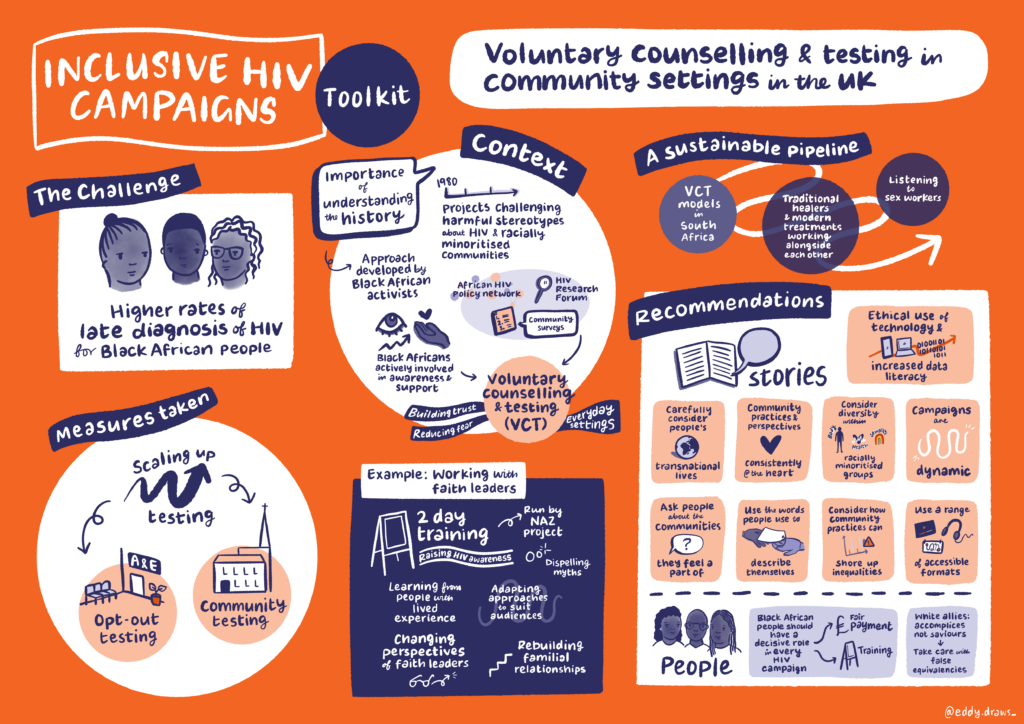
Visual notes designed by Eddy Phillips